Presentation
Any company, regardless of industry, size, or geographic location, shares two things in common: some kind of structure, whatever form it takes, and an organizational culture, whether deliberately built or emergent. These two things are linked in defining how hierarchical the company's structure will be and how many levels are needed to accommodate the management of its different areas, as well as determining which areas are responsible for which parts of the business. While these structures may seem permanent and fundamental at first glance, they aren't always healthy or unobstructed, since that requires carefully organizing leadership passages, with clearly established duties and responsibilities that, as much as possible, don't overlap.

The book "The Leadership Pipeline: How to Build the Leadership-Powered Company" [1], written by Ram Charan, Stephen Drotter, and James Noel, presents a model for understanding and developing the different layers of leadership within an organization. It suggests that developing effective leaders requires a clear understanding of the requirements, challenges, and transitions associated with each stage of the structure.
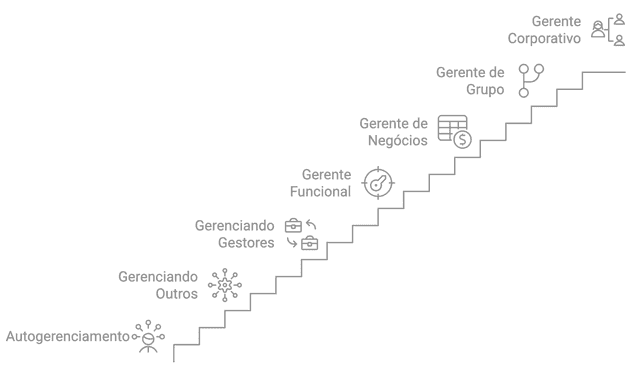
This structure, referred to as the "pipeline," resembles a ladder the professional climbs, made up of seven levels. At each level transition, a new leadership passage occurs, with each level represented by a given role within an organizational structure, as listed in Table 1.
| Pipeline Level | Representative Role | Brief Description |
|---|---|---|
| 1. Managing Self | Individual Contributor | Focused on developing technical and professional skills, managing their own time and tasks. |
| 2. Managing Others | Team Leader / Supervisor | Responsible for managing the work of others, motivating the team, and evaluating performance. |
| 3. Managing Managers | Manager of Managers / Director | Focused on coaching other managers, developing their leadership and strategy skills. |
| 4. Functional Manager | Department Manager | Oversees a specific area of the company, such as finance or marketing, implementing functional strategies. |
| 5. Business Manager | General Manager / Business Unit CEO | Responsible for a business unit's overall performance, including profitability and market strategy. |
| 6. Group Manager | Group CEO / Vice President | Manages multiple business units or regions, ensuring strategic and operational alignment. |
| 7. Enterprise Manager | CEO / President | Leads the organization as a whole, setting corporate vision and strategy, and shaping organizational culture. |
Table 1. Pipeline levels and their corresponding role in a traditional company.
The levels and their respective leadership passages are represented by the authors through the pipeline illustrated in the figure referenced below. Figure 1 shows the progression of each stage within the organizational structure.
In this review, I'll summarize the main ideas behind the first two passages, along with some reflections on why each one needs to be firmly established.
From Individual Contributor to the Tactical Level
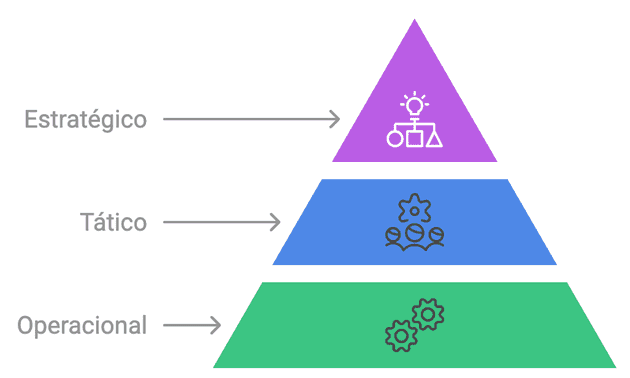
Business management has long established that, broadly speaking, there are three organizational levels within companies: the operational level, tied to day-to-day, short-term tasks; the tactical level, which translates strategic guidelines into medium-term action plans; and the strategic level, which defines the organization's overall direction and long-term goals.
Well-defined, with a clear starting point, early-career professionals will spend their first years in an organization as individual contributors, usually assigned well-defined, short-duration tasks with very clear goals.
At this stage, the professional will be focused on shaping their skills, their time management, and their professional values, along with other traits that demonstrate the ability to take on responsibility and respect the company's values. Once these three areas are reasonably developed, this professional is typically promoted to a first-level leader or manager.
"To develop effective leaders [...], organizations need to identify leadership candidates early, give them growth assignments, provide them with useful feedback, and coach them. (p.31)"
It's worth noting that the job title can vary from company to company — it might be leader, coordinator, first-level manager, and so on — but the key point is that, in this first leadership passage, the new leader will be managing not just themselves, but other people too, which requires a behavioral shift and a fundamental change in skills and values for success in the role.
These new skills, described in Table 2, include planning the work, assigning tasks, motivating, and critically evaluating the work done by others — in other words, not just completing the work assigned to them, but also helping others reach an expected level of performance. At this point, it's crucial that managerial work be valued, not merely tolerated, since making time to address the team's needs, clarify doubts, and pursue contact and dialogue with other teams, departments, and vendors is essential for helping their reports reach their goals — and, in turn, for determining the leader's own success.
For new leaders, letting go of the tasks and skills that got them promoted into a leadership role can be challenging, but it's necessary to understand that, at this new level, results are achieved through others. Direct reports' success reflects the leader's own success. So, it's essential to see yourself as a manager, one who defines the work to be done and lets it be carried out by their reports, with trust and accountability, teaching rather than just correcting mistakes, and staying close to the problems and failures the team faces. Leaders at this first passage must, above all, be accessible and available, both physically and emotionally, showing that, through that accessibility, they've mastered managing their own time.
| Aspect | Individual Contributor | First-Level Manager |
|---|---|---|
| Skills | Technical/functional mastery, teamwork, building relationships for personal benefit, using tools/processes | Planning, job design, staffing, delegating, monitoring, coaching/feedback, performance evaluation, motivating, communicating, building relationships for the department's benefit, acquiring resources |
| Time Management | Daily discipline, meeting personal deadlines, managing their own time | Annual planning, availability for direct reports, setting priorities, time spent communicating with other areas |
| Professional Values | Getting results through their own proficiency, high-quality work, embodying the company's values | Getting results through others, direct reports' success, the department's success, integrity |
Table 2. Traits of the first leadership passage. (Adapted from: CHARAN, Ram; DROTTER, Stephen; NOEL, James, 2011, p.64)
When leaders lack an aptitude for time management, they run into trouble planning tasks and setting priorities for the team. As a result, they'll often lack the time to support their direct reports, which will clog up the flow of work and probably overload both themselves and everyone else. Likewise, the absence of proper professional values leads to difficulty delegating tasks. These leaders often choose to do the tasks themselves rather than plan the work. This leads to a lack of proper managerial methods, making the work environment chaotic and relationships and communication with other teams unstable or ineffective.
The second passage — to manager of managers — should mark a complete shift from operational focus to the tactical management of teams, while also prioritizing the development of new leaders. This includes mentoring, coaching, ongoing feedback and evaluations, and delegating tasks that push them to practice time-management skills suited to leading a team.
When these leaders are poorly trained or coached, certain management problems can surface, signaling that these managers of managers may be in the wrong role, or that they haven't yet fully developed their skills, time management, or professional values. Among these problems are difficulty delegating, poor management of first-level managers' performance, an inability to build a strong team — perhaps the biggest problem of all, especially when favoritism is at play and there's a lack of proper evaluation based on competence — an excessive focus on doing the work themselves, and a tendency to select people who are clones of themselves, rather than choosing for diversity and competence.
For managers of managers to excel in their role, they should focus on selecting and training highly competent new managers, holding those leaders accountable for the managerial work they've done, allocating resources across units as needed, and managing the boundaries between each unit according to the established organizational structure.
Notice that, in the pipeline model established by the authors, there's no overlap of roles. Clearly defining the skills, time management, and professional values expected at each stage of the process creates an environment conducive to the emergence of new leaders. This eliminates the need to hire exclusively from outside for standout talent, allowing internal leaders to be developed so they can carry out their roles properly, without competition between leaders and their reports over the same action.
Finally, by establishing the right requirements for the different leadership levels, succession planning becomes easier, reducing the emotional strain on newly promoted leaders. As the authors point out, "when someone skips leadership passages and is placed in a position for which they lack the necessary skills, time-management mastery, and professional values, the emotional impact is significant. The pipeline model makes skipping those passages unlikely."
Closing thoughts
Establishing roles within an organizational structure is always a challenge. It becomes even harder when those definitions aren't clear and objective, or when there's no formal coaching and development plan led by the upper levels, who, according to the authors, are the ones responsible for developing successors. The absence of these definitions creates gaps in the pipeline, leading to overlapping roles: managers doing operational work instead of managing it is perhaps the clearest symptom of neglecting the skills, time management, and professional values needed to achieve exceptional performance in the role.
While this dysfunction is common, addressing it is essential. Developing leaders at the earlier levels of an organizational structure, who meet the requirements described above, is indispensable. After all, it's at the operational and tactical layers that every company, regardless of size or industry, generates its revenue through the development of products and services. These levels also represent the entry point for new talent, whether through hiring or internal development.
Finally, adopting this model represents a vital strategic step for organizations that want to not only stay competitive in an ever-evolving market, but also secure a strong, sustainable leadership legacy for years to come.